
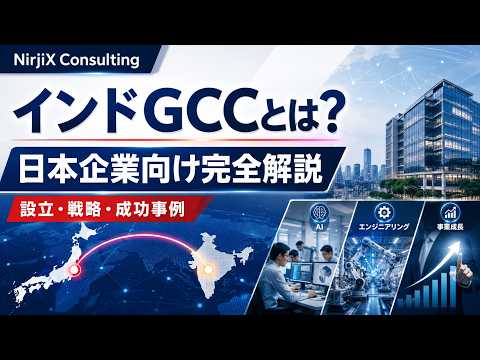
NirjiX Consulting
インド進出を検討中の企業へ。NirjiXが提供するGCC設立から事業基盤構築までの包括的なサポート体制と、成功事例を解説します。
Published: Duration: 14:58Watch on YouTube
Japan × India · Manufacturing authority
Japan-side advisory. India-side manufacturing execution.
NirjiX helps Japanese companies evaluate, establish and scale manufacturing operations in India. We support the full decision journey — from India feasibility, investment business case and incentives to state and site selection, operating-model choice, factory setup, suppliers, workforce, systems, commissioning and production ramp — while connecting Japan-headquarters decision making with India-side execution.
Japan × India manufacturingWritten by NirjiX Manufacturing AdvisoryReviewed by Reviewed by the NirjiX Manufacturing practice, which advises global OEMs, GCC operators and PE portfolio companies on India manufacturing strategy, site selection and factory execution.Published January 2026Last reviewed February 202616 min read
Direct answer
It depends on whether India is being evaluated as a market and capability strategy or only as a cheaper substitute for an existing plant. For Japanese manufacturers with a credible India or export demand case — automotive and components, industrial machinery, electronics and EMS, energy equipment, medical devices — India is now a defensible primary or second production base, and the decisive variables are supplier maturity in the chosen cluster, realisable incentives, the operating model, and the governance interface between Japan headquarters and the Indian plant. Where the driver is labour arbitrage alone, the case usually weakens once landed cost, ramp yield, supplier qualification and Japanese quality expectations are modelled honestly. NirjiX runs that evaluation as one engagement: a Japanese-language advisory interface into headquarters decision making, and India-side capability to take the decision through site, approvals, suppliers, workforce, systems, commissioning and ramp.
Three separate pressures are pushing Japanese manufacturers toward India at the same time, and they lead to different projects. The first is supply-chain concentration: boards that spent the last decade with one dominant Asian production and sourcing base are now required to demonstrate an alternative. The second is demand: India is one of the few large markets where automotive, construction equipment, electrification, electronics assembly and healthcare volumes are still growing, and serving that demand from Japan is rarely competitive after freight and duty. The third is domestic capacity: shrinking Japanese manufacturing labour supply and an ageing skilled workforce make additional home-country capacity difficult to justify.
These drivers matter because they determine what "success" means. A resilience-driven project is judged on qualified dual-source capacity and time to first shipment. A market-driven project is judged on landed cost to Indian customers and on localisation depth. A capacity-driven project is judged on transfer of process capability without quality loss. Japanese groups get into trouble when the board approves a project for one reason and the India team is measured on another.
The bilateral frame is unusually supportive. Japan and India operate a Comprehensive Economic Partnership Agreement, a long-running government-to-government investment relationship, dedicated Japanese industrial townships in several Indian states, and JETRO support infrastructure on the ground. None of this makes a project succeed, but it removes several of the frictions that make first-time manufacturing entry elsewhere expensive.
The honest counter-position: India is not a low-effort substitute for an existing, mature plant. Component ecosystems are deep in some clusters and thin in others, land and approvals vary by state more than by country comparison, and the first two years consume management attention disproportionate to revenue. That is precisely why the decision deserves a structured evaluation rather than a site visit and a spreadsheet.
The underlying economics of manufacturing in India are the same for everyone. The decision process is not. Six differences change the shape of the work when the parent is Japanese.
Decision cadence and consensus. Approval moves through 稟議-style consensus building rather than a single sponsor's authority, so the material has to be complete, internally consistent and written to be circulated — not presented. A recommendation that cannot be defended in writing, in Japanese, by a manager who was not in the room will not clear the gate, however strong the economics.
Quality definition. Japanese quality expectations are usually expressed as process discipline — standard work, defect prevention at source, traceability, supplier process audits — not as an outgoing AQL number. That changes supplier selection, line design, training investment and the ramp curve, and it is the single most common reason an India business case that looked good on unit cost underperforms.
Engineering control. Drawings, tolerances, tooling and process specifications typically remain owned in Japan. The India operating model has to define who may change what, how engineering change requests flow across time zones and languages, and what is transferred versus retained — before the plant is built, not during ramp.
Capital approval and reporting. Capex committed in JPY against an INR cost base introduces currency, phasing and depreciation questions that Japanese finance functions test carefully. The India entity's reporting calendar and account structure need to reconcile to the parent's consolidation from day one.
Language and management interface. A plant that reports upward only in English through a single bilingual manager creates a bottleneck and an information risk. Governance design has to state which forums are Japanese-language, which reporting is bilingual, and how escalation reaches Japan without depending on one individual.
Long-horizon partner logic. Japanese manufacturers generally evaluate suppliers, JV partners and advisers on multi-decade fit rather than transactional price. That should be applied consciously in India, where partner selection is the highest-variance decision on the board.
This is the global NirjiX India Manufacturing Decision Framework with the dimensions that behave differently for a Japanese parent made explicit. It is the structure we use to take a Japanese group from initial question to an approved, executable India manufacturing decision — nothing is added simply to make the framework look Japan-specific.
NirjiX Japan–India Manufacturing Decision Framework
India domestic demand, export platform, China+1 resilience, customer proximity and localisation requirements — stated as one primary objective, because the objective determines every later trade-off.
Capex, run-state opex, landed cost to the customer, incentive treatment, tax, working capital for a longer inbound pipeline, and NPV / IRR / payback tested against the ramp curve rather than design capacity.
Greenfield, brownfield expansion, acquisition, joint venture, contract manufacturing or a staged hybrid — evaluated on control, speed, IP exposure and exit flexibility, not on ownership preference.
State policy, industrial corridor, land and utilities, port and logistics access, talent depth and — decisively for Japanese manufacturers — the maturity of the Tier-1 and Tier-2 supplier base for your specific product.
Central schemes including PLI where applicable, state incentives, stacking rules, conditions, disbursement timing, compliance load and clawback exposure — modelled as conditional cash flow, never as headline percentage.
How Japanese process discipline is transferred, which engineering authority stays in Japan, how proprietary process technology is protected contractually and physically, and what the quality ramp genuinely costs.
Supplier maturity by cluster, qualification effort per part, tooling ownership, the localisation sequence over three to five years, and which parts stay imported deliberately rather than by default.
Decision rights between Japan and the plant, reporting lines, Japanese-language forums, bilingual reporting, escalation paths and capital-approval gates — designed before ramp, not negotiated during it.
Land, approvals and consents, EPC, machinery import versus local sourcing, utilities, ERP/MES, recruitment and training, commissioning and the production-ramp plan with named accountability on both sides.
Expansion path, multi-site optionality, automation trajectory, supply-chain risk cover and the contingency that applies if demand, policy or partner assumptions move.
Each dimension has a methodology page behind it. This page states the Japan-specific reasoning; the full method sits in the India Manufacturing decision guides linked throughout.
Build the case on fully landed cost to the customer, not on factory-gate conversion cost. For a Japanese manufacturer the four blocks are: capital to reach saleable production; run-state cost at realistic first-year yield and utilisation; incentives that are actually realisable under their conditions; and the risk value of holding qualified alternative capacity. Presenting these separately is what makes the case auditable — and therefore approvable.
The Japan-specific adjustments are consistent enough to name. Ramp is longer when Japanese quality gates are applied properly, and the case should say so rather than absorbing the difference silently. Imported components, tooling and machinery carry duty, freight and lead time that must sit in the model until localisation actually happens. Expatriate or bilingual leadership cost is a real line, not an overhead footnote. And currency phasing between JPY capex and INR operating cost belongs in the sensitivity, not in a note.
The test we apply before a case goes to a Japanese investment committee: can the paper survive being read cold, in Japanese, by finance and by the plant-side stakeholders, with every material assumption traceable to either an external source or a named internal input? If not, it is a proposal, not a business case.
Indian central and state incentives are material and real, but headline percentages are not project economics. Japanese boards are rightly sceptical of subsidy-led cases, so we model incentives as conditional cash flow with an explicit distinction between what a scheme offers and what a specific project will receive.
| Layer | What it means | How NirjiX treats it in the case |
|---|---|---|
| Scheme eligibility | Whether the product, entity, investment threshold and timeline actually qualify under the notified scheme. | Binary gate, tested first. An ineligible project has no incentive line at all. |
| Headline incentive | The published rate or quantum a scheme advertises. | Never entered as value. Recorded as the upper bound only. |
| Realisable incentive | What the project can claim after conditions, caps, domestic value-addition rules and documentation reality. | Modelled as the base case, with an explicit claim assumption stated in the paper. |
| Disbursement timing | When cash actually arrives relative to when investment is made. | Discounted in the cash-flow model; never netted against capex in year zero. |
| Conditions and milestones | Investment, employment, production or value-addition commitments attached to the incentive. | Converted into obligations in the project plan, with the cost of meeting them included. |
| Central + state stacking | Whether state incentives can be combined with a central scheme, and on what basis. | Assessed state by state; assumed non-stackable until confirmed in writing. |
| Compliance and clawback | Ongoing reporting load and the exposure if commitments are missed. | Priced as a running cost and as a downside scenario, not ignored. |
There is no universally best Indian state for a Japanese manufacturer, and any adviser who names one before understanding your product is selling a relationship, not an analysis. The right location is a function of your bill of materials and supplier depth, your export or domestic customer geography, port and corridor access, power reliability and cost, water and effluent requirements, workforce availability at your skill profile, land readiness, and the incentive package you can actually realise.
For Japanese entrants, three factors carry more weight than in a generic screen. Supplier ecosystem density for your specific part families usually dominates, because qualification effort is the hidden cost of an India plant. Existing Japanese industrial concentration matters — dedicated Japanese industrial townships and established clusters reduce friction in approvals, vendor availability, expatriate living conditions and peer benchmarking, and JETRO and state agencies publish current information on these. And logistics reliability to the customer, not distance, decides whether landed cost holds.
Our sequence is deliberately narrow-then-deep: screen states on policy, ecosystem and logistics; shortlist three; then evaluate specific sites on land title and readiness, utility connections, effluent and environmental clearance path, labour catchment, and the incentive package negotiated in writing. A site decision made on state-level averages is the most expensive shortcut in the project.
Japanese groups often start with a preference for a wholly owned plant. That is sometimes right and sometimes an expensive way to answer a question that could have been tested faster. Evaluate the routes against control, speed, capital, IP exposure and exit flexibility for your actual objective.
| Route | Control & IP | Speed to production | Best fit |
|---|---|---|---|
| Greenfield wholly owned | Highest control; process technology and engineering authority stay with the parent. | Slowest — land, approvals, construction, commissioning. | Committed long-horizon volume, proprietary process, quality-critical products. |
| Brownfield / expansion | High control where an Indian entity already exists. | Faster than greenfield; constrained by the existing site. | Groups already present in India adding product lines or capacity. |
| Acquisition | Control acquired with legacy practice; integration risk on quality culture. | Fastest route to capacity, customers and licences. | Buying market access, a customer base or a qualified supplier position. |
| Joint venture | Shared control; IP protection depends entirely on structure and scope discipline. | Moderate; partner capability can compress approvals and supplier access. | Regulated sectors, local channel dependence, or genuine complementary capability. |
| Contract manufacturing / EMS | Lowest control; IP exposure managed by design partition and contract. | Fastest to first shipment with no capex. | Testing demand, moderate volumes, or non-differentiating products. |
| Hybrid / staged | Control increases in steps as volume and confidence build. | Early output first; owned capacity later. | Uncertain demand, or when speed to market outweighs ownership today. |
The execution stages are the same as any India plant; what changes for a Japanese parent is the approval gating, the engineering interface and the quality ramp. NirjiX runs these stages with named accountability in Japan and in India rather than handing over a report at the strategy stage.
Objective, product scope, landed-cost model, incentive view and go/no-go paper written for a Japanese approval process.
State shortlist, site diligence, entity structuring, incentive negotiation and written commitments before land is committed.
EPC and layout to your process standard, machinery import versus local sourcing, utilities, ERP/MES integration, supplier qualification and tooling.
Recruitment and training, trial production, quality gate sign-off with Japan engineering, ramp governance, localisation sequencing and productivity improvement.
Cross-border details that decide the schedule: equipment import classification and clearance, drawing and specification control, vendor qualification lead time, HQ approval gates at each stage, expatriate versus local leadership, and who signs off the first production part approval.
This is where Japanese India projects are actually won or lost. Labour cost is visible on day one; supplier capability and process discipline decide the cost structure from year two onwards.
Governance is a design decision, not an org chart drawn after hiring. These are the elements we specify before ramp for Japanese parents.
Sector determines cluster, supplier depth, regulation and incentive eligibility. Each link below is the full India sector decision guide; the Japan-relevant point is stated here.
There is no credible independent ranking of India manufacturing advisers for Japanese companies, and we will not publish a self-serving one. These are the criteria we would apply if we were the buyer — apply them to NirjiX as strictly as to anyone else.
NirjiX operates a Japan-side advisory interface and India-side manufacturing execution capability within one engagement. In practice that means the same firm prepares the headquarters decision material and is accountable in India for site, approvals, supplier qualification, workforce, systems, commissioning and ramp governance.
We state that factually rather than comparatively. We do not claim to be the largest or the best-ranked adviser in this market, and no independent evidence would support such a claim. What we will commit to is the structure above: one framework, one accountable team across both countries, and analysis that separates external evidence from our own judgment.
Japan × India manufacturing facts move quickly — incentive rules, state policies and investment figures in particular. Anything on this page that depends on a current external fact is listed here with its issuing authority. Numbers used in a client business case are re-verified at the time of the engagement.
Reference period: Verify against the position in force at the time of your decision (page reviewed February 2026).
Tariff lines, rules of origin and phase-outs determine landed-cost treatment for imported components and exported finished goods, and must be checked line by line for your bill of materials.
Source: Ministry of Foreign Affairs of Japan — Japan–India EPA
Scheme scope, application windows and disbursement conditions change. Eligibility must be confirmed against the current notification for your specific product before any incentive value enters a business case.
Source: Invest India / DPIIT — Production Linked Incentive schemes
Applies to fabs, ATMP/OSAT, display and design-linked incentives; the applicable route depends on which part of the value chain a Japanese entrant is targeting.
Source: India Semiconductor Mission
Use JETRO's published survey as the reference point for Japanese corporate presence and operating conditions rather than an adviser's summary figure.
State incentives are negotiated and documented per project; stacking with central schemes is not automatic and should be confirmed in writing before site commitment.
These are practitioner observations, not published benchmarks. Project-specific timelines are built from your product, state, site and approval path — we do not quote a generic month count.
Where this page states a pattern without a source, it is NirjiX judgment and is labelled as such. We do not reproduce investment, salary or incentive figures we cannot attribute.
Our advice is conditional on a specific set of assumptions. These are the movements that would change it, and how.
NirjiX view
The cheapest Indian location rarely produces the lowest long-term operating cost for a Japanese manufacturer. Wage differentials between states are small relative to what supplier immaturity, logistics unreliability and quality escapes cost over a five-year horizon. Choose the cluster where your part families can be qualified, and accept a higher nominal cost base to get it.
Treat incentive value as a conditional cash-flow variable, never as project economics. A case that only works with the incentive is a case that does not work. Model the project without it, then treat the realisable portion as upside with its conditions and timing attached.
Supplier qualification and localisation matter more than labour arbitrage. The saving that appears in the first spreadsheet is a conversion-cost saving; the saving that shows up in the P&L three years later comes from localised content, stable yield and a supplier base that no longer needs Japanese engineering supervision.
Design decision rights between Japan HQ and India plant leadership before ramp. Almost every governance dispute we see in year two was avoidable in month three: it exists because approval thresholds, engineering-change authority and escalation routes were never written down while everyone was aligned.
Greenfield ownership is strategically attractive and frequently the wrong first move. When demand is uncertain and speed matters, a contract-manufacturing or partner-led start that converts to owned capacity preserves both the option and the capital — and it produces real market evidence rather than a longer study.
Finally, evaluate India as a capability and market strategy, not as a China+1 cost replacement. Projects framed purely as cost substitution tend to be under-resourced, judged against the wrong metric, and abandoned in the ramp period. Projects framed as building a manufacturing and market capability survive the second year, which is the only year that decides the outcome.
Continue
Transparency
This page reflects the NirjiX Japan–India Manufacturing Decision Framework and the firm's engagement experience advising manufacturers on India feasibility, incentives, site selection, factory setup and production ramp, together with Japan-side headquarters engagement.
External facts — trade agreement status, incentive scheme structures, semiconductor policy and Japanese corporate presence in India — are attributed to the issuing authority in the evidence section above and carry a verification instruction rather than a snapshot figure. Scheme rules and state policies change, so nothing here should be used in a board paper without confirmation against the position in force.
No investment, incentive, salary or setup-timeline figure is presented as a market benchmark. Those are engagement inputs built from your product, sector, state and approval path.
A structured executive assessment across strategic rationale, economics, operating model, location, incentives, supply chain, governance and execution readiness — the same journey used by every NirjiX manufacturing client, with your Japan context carried through.
One journey, one team. The assessment feeds the same business case and execution work — there is no separate Japan intake form.
Video
Growth, sales, succession and AI — the NirjiX approach, in short videos.
NirjiX Consulting
インド進出を検討中の企業へ。NirjiXが提供するGCC設立から事業基盤構築までの包括的なサポート体制と、成功事例を解説します。
Published: Duration: 14:58Watch on YouTube
A chaptered summary transcript of what each video covers.

設立・構築・運営の完全ガイド【NirjiX】
すでに160社を超える日本企業が、インドにGCC(グローバル・ケイパビリティ・センター)や技術拠点を設立しています。GCCの基礎から、設立で直面する課題と解決策、5つのステージ、モデルの選び方、導入事例までを解説します。
Published: Duration: 26:31Watch on YouTube
A chaptered summary transcript of what each video covers.

Nirji SPO
セールスプロセスアウトソーシング(SPO)を活用して、企業の収益成長を加速させるための具体的な手法を解説します。営業組織の構築からグローバル展開まで、貴社のニーズに合わせた柔軟な支援体制について紹介します。
Published: Duration: 10:46Watch on YouTube
A chaptered summary transcript of what each video covers.

Nirji SPO 第1話
営業の壁を突破し、売れる仕組みを作るための5段階プロセスを漫画で分かりやすく解説します。良い製品なのに売れないという悩みを抱える営業担当者や経営者必見の内容です。
Published: Duration: 6:30Watch on YouTube
A chaptered summary transcript of what each video covers.

Nirji X 第2話「価値で稼ぐ」
コンサルティングの報酬は、費やした時間ではなく、生み出した成果で決まるべきだ ―― Nirji X の価値コンサルティング・シリーズ第2話「価値で稼ぐ」。
Published: Duration: 12:28Watch on YouTube
A chaptered summary transcript of what each video covers.

Nirji X Consulting
日本の中小企業が直面する後継者不足問題と、技術や信頼を次世代へ引き継ぐための具体的な解決策を解説します。廃業の危機を乗り越え、事業継続を成功させるための道筋を学びましょう。
Published: Duration: 8:39Watch on YouTube
A chaptered summary transcript of what each video covers.